

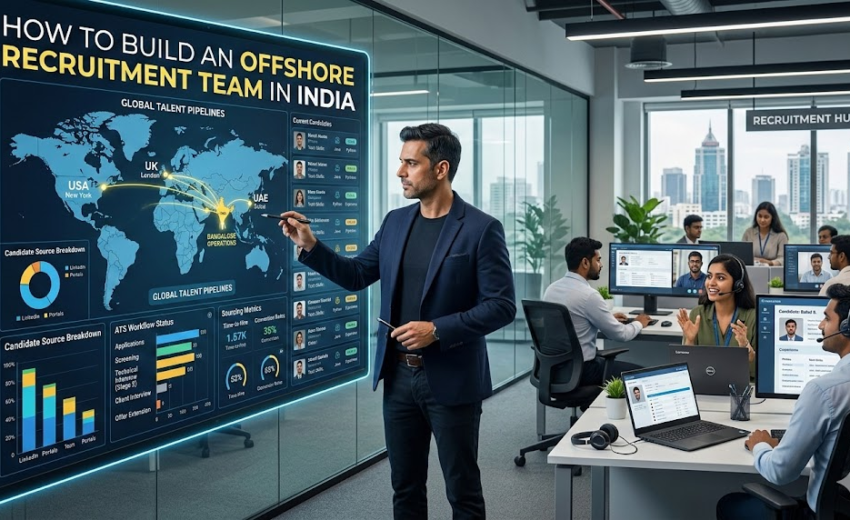
Global recruitment teams are now table stakes. It’s all about how to architect it, so it actually works. For high-growth firms in the US, UK, and UAE, building an offshore recruitment team in India has become a strategic lever.
But here is the reality: most leaders treat offshore teams as a “plug-and-play” utility. They hire five recruiters, give them a LinkedIn Recruiter license, and expect placements to double overnight. When it doesn’t work, they blame the “cultural gap.”
After 21 years in staffing and operations, I’ve seen exactly where the gears grind to a halt. Success isn’t about the where but it’s more about the how. If you want to scale your hiring capacity by 3x while reducing your overhead by 60%, you need a blueprint that accounts for the nuances of the Indian talent ecosystem.
Why India Remains the Strategic First Choice in 2026
While regions like Eastern Europe and Latin America have gained traction for niche engineering, India remains the undisputed powerhouse for Business Process Management (BPM) and Recruitment.
1. The Depth of Specialization
India’s staffing hubs (Bangalore, Pune, Chennai) have spent 15+ years perfecting recruitment operations. They’ve trained thousands of recruiters on ATS platforms like Bullhorn and Greenhouse. They understand what “culturally fluent with US/UK hiring standards” actually means, not through generic training, but through operational muscle memory.
When you hire from these hubs, you’re entering into an ecosystem where recruiters already speak the language of your hiring process. That’s not luck but infrastructure.
2. The Real Challenge: Finding the Top 5%
The uncomfortable truth: most graduates from that 1.5 million pool aren’t recruitment-ready. They lack the communication precision, the critical thinking, and the ability to push back on hiring managers when a role is unrealistic.
The differentiator isn’t access to talent. It’s the screening process. A great offshore recruitment partner doesn’t just hand you bodies, they’ve already filtered for the 5% who can operate independently in a low-context culture.
3. The 24/7 “Follow-the-Sun” Advantage
When your internal team in New York or London signs off, your Indian team picks up the baton. This creates a continuous recruitment cycle.
- Morning (India): Sourcing and screening candidates.
- Evening (India) / Morning (US): Handing over “warm” candidates for final interviews.
- Result: Your time-to-hire drops by an average of 30%.
The 3 Pillars of a “Chaos-Free” Offshore Setup
Before you post a single job opening, you must decide on your structural foundation. In my experience, there are three ways to do this:
Pillar 1: The Virtual/EOR Model (Best for 1–5 People)
If you’re testing the waters, use an Employer of Record (EOR). You find the talent, and the EOR handles the local payroll, taxes, and compliance.
- Pros: Low risk, no legal entity required.
- Cons: You still own 100% of the training and daily management.
Pillar 2: The Managed Staffing Model (Best for Rapid Scaling)
This is where you partner with a specialized firm that provides both the recruiters and the management infrastructure.
- Pros: High accountability. The partner is responsible for the KPIs (Submissions-to-Interview ratio, etc.).
- Cons: Higher initial cost than a raw EOR, but significantly higher ROI due to reduced “management drag.”
Pillar 3: The GCC (Global Capability Center)
You set up your own legal entity in India.
- Pros: Total control, long-term brand equity in India.
- Cons: Extremely high setup cost ($200k+ just for compliance and infrastructure) and a 6–12 month lead time.
The Step-by-Step Blueprint: Building Your India Recruitment Engine
Setting up the team is the easy part; making it perform is where most leaders fail. If you want to avoid the “chaos” of misaligned expectations, follow this operational framework.
Step 1: Define the “Sourcing vs. Full-Cycle” Split
Don’t just hire “recruiters.” Define their scope. In my 21 years of staffing, I’ve found that offshore teams thrive when their roles are hyper-defined:
- The Sourcers: Focused entirely on top-of-funnel. Their KPI is “Qualified Leads per Day.”
- The Full-Cycle Recruiters: They handle everything from the initial reach-out to the technical screening and offer negotiation.
- The Admin Support: Handling ATS data entry, interview scheduling, and background check coordination.
Pro Tip: Start with 2 Sourcers and 1 Full-Cycle Lead. This creates a “pod” structure that is easily repeatable as you scale.
Step 2: Cultural & Technical Integration (The First 30 Days)
The biggest mistake is treating the India team as a “vendor” rather than an extension of your HQ.
- Shared Slack/Teams Channels: They must be in the same digital room as your onshore team.
- Shadowing Sessions: Have your India team “shadow” your best onshore recruiters during intake calls with hiring managers. They need to hear the nuance of what a “good candidate” sounds like.
- The “Why” Briefing: Don’t just give them a JD. Explain the company mission. If they don’t buy into your brand, they can’t sell it to candidates.
Step 3: Essential Technology Stack
In 2026, you cannot manage an offshore team via email. You need a transparent tech stack to maintain “Zero Bad Debt” in your operational workflow.
- ATS (Applicant Tracking System): Bullhorn, Greenhouse, or Lever. Ensure they have “Full Access” to avoid bottlenecking.
- Cloud Telephony: Use VOIP tools like Aircall or RingCentral so they have local US/UK numbers. This dramatically increases candidate pick-up rates.
- AI Sourcing Tools: Equip them with LinkedIn Recruiter, SeekOut, or Lusha.
The 5 KPIs That Actually Matter
Stop tracking “number of calls.” It’s a vanity metric that leads to burnout and low-quality talent. Instead, hold your offshore team accountable to these five metrics:
| KPI | What It Measures | Benchmark for Success |
| Submissions to Interview (S2I) | Quality of sourcing. | 3:1 (3 resumes sent = 1 interview) |
| First-Week Retention | Alignment with candidate expectations. | >95% |
| Time to Submittal | Speed and urgency. | <48 Hours from Job Opening |
| Offer Acceptance Rate (OAR) | Negotiating and “closing” skills. | >80% |
| ATS Health Score | Operational discipline. | 100% Data Accuracy |
Overcoming the “Cultural Nuance” Gap
India is a high-context culture; the US and UK are low-context. This is where the “chaos” usually starts.
- The “Yes” Problem: In Indian professional culture, saying “No” to a superior can feel disrespectful. To fix this, encourage “Red-Flag Reporting.” Reward recruiters who identify why a role won’t be filled easily.
- Communication Styles: Move from “Did you do the task?” to “What challenges did you face while doing the task?” This shifts the conversation from defensive to collaborative.
India vs. The World: The 2026 Cost & Capability Matrix
When CHROs ask me why they should choose India over “nearshore” options like Latin America or other “offshore” hubs like the Philippines, I point to the Total Cost of Ownership (TCO).
While a recruiter in Mexico or Poland might offer better timezone alignment, the “Depth of Market” in India is unparalleled for recruitment operations.
Comparative Analysis: Recruitment & Staffing (2026 Benchmarks)
| Region | Avg. Hourly Rate (USD) | Primary Strength | The “Hidden” Challenge |
| India | $12 – $28 | Deep technical sourcing & high-volume scale. | Timezone management (requires overlap shifts). |
| Philippines | $10 – $22 | Excellent voice-based CX and English fluency. | Specialized technical sourcing depth is lower. |
| Latin America | $35 – $65 | Near-perfect timezone alignment with the US. | Significantly higher labor cost for scale. |
| Eastern Europe | $30 – $55 | High-end niche engineering recruitment. | Geopolitical volatility and rising wage inflation. |
The “India Premium” in 2026
The advantage in 2026 is not simply labor arbitrage. It is workflow leverage. Recruitment hubs in India have rapidly integrated AI into sourcing, screening, and candidate engagement processes. The result is not automation replacing recruiters, but structured augmentation.
For example, in high-volume technical roles, AI-assisted Boolean refinement reduces manual search calibration time from 45 minutes to under 10. AI-generated screening summaries cut resume review time by more than 50 percent. That reclaimed time is redirected toward live candidate qualification and hiring manager alignment.
The outcome is measurable. A structured three-person sourcing pod, supported by AI tools, can produce the output of a traditional five-person team without increasing working hours. This is where the real productivity delta exists in 2026.
Conclusion: Moving from “Chaos” to “C-Suite” Impact
Building an offshore recruitment team is not a project; it is an operational transformation. If you treat it as a secondary “back-office” function, it will yield secondary results. But if you integrate it as a core engine of your workforce architecture, it becomes a competitive moat.
After two decades of building these engines, my advice is simple: Don’t scale until you’ve standardized. Build the playbook first, then find the partners who can execute it with the same level of P&L ownership that you expect from your internal leadership.
Let’s Build Your Global Talent Engine
Is your current recruitment process failing to keep up with your growth? Whether you are looking to set up your first offshore “pod” or want to audit your existing Indian operations for “Zero Bad Debt,” I can help. As a Founding Partner at Skilligent, I specialize in transforming fragmented staffing operations into high-performing, scalable engines.
Ready to stop the chaos?
- [Book a Strategy Audit] – Let’s look at your current hiring bottleneck.
- [Download the Offshore Playbook] – My 10-point checklist for 2026 recruitment success.
- [Connect with me on LinkedIn] – For daily insights on staffing, operations, and leadership.
Let’s build something meaningful together!

March 16, 2026